

Zoning Enforcement
Planning staff frequently conduct property inspections and respond to complaints in the Town of Wake Forest for violations of the Town’s Ordinances.
The Planning Department strives to correct all applicable violations within a timely and effective manner. All violations are promptly addressed in an effort to protect public safety and general welfare.
This webpage is meant to assist you with correcting certain violations that are common. For violations that are not listed below, please reach out to the Zoning Enforcement Officer for assistance.

Did you receive a violation?
An official Notice of Violation and Correction Order will be sent to the property owner of the address of the violation through certified mail and it will look like the example to the right.
It contains the following information:
- Chapter: Which Ordinance is in violation
- Type of Violation: The type of violation, this example being a sign without a permit
- Corrective Action: How to correct the violation
See the Common Violation dropdowns for more information on types of violations.
Do you want to report and view violations?
Residents wishing to do their part in keeping the Town violation-free are welcome to utilize our online application, SeeClickFix, to report violations. SeeClickFix is used for many types of problems that the Town can assist with, zoning enforcement being one.
Click the button below to access SeeClickFix.
SeeClickFix(opens in a new tab)(opens in a new tab)
Zoning Enforcement Violations Dashboard
The Town of Wake Forest utilizes a web-based dashboard(opens in a new tab)(opens in a new tab) that allows residents to view zoning enforcement violations by address. The platform also allows residents to track the type of violation, the current number of open and closed cases, and the Town’s response.
Zoning Enforcement Violations Dashboard(opens in a new tab)(opens in a new tab)
Town Codes
The Town has two Ordinance codes: the Municipal Code of Ordinances and the Unified Development Ordinance (UDO). See the table below for a high-level overview of the differences between the two.
Code of Ordinances | Unified Development Ordinance (UDO) | |
|---|---|---|
| What is it? | A collection of all permanent ordinances for the town | Combined development ordinance that contains regulations for zoning, subdivision, land use, grading, stormwater management, and historic preservation |
| Where does it apply? | The Town's Corporate Limits | The Town's Corporate Limits + Extra-Territorial Jurisdiction (ETJ) |
| Who enforces it? | Zoning Enforcement Officers (nuisance code) and Law Enforcement Officers | Zoning Enforcement Officers and Planning Staff |
| Where do I access it? |
Common Code Violations
Typically, violations of the Trash and Debris Ordinance are complaints from neighbors who refer to the Town of Wake Forest Code of Ordinances 14-23(opens in a new tab)(opens in a new tab) which prohibits various items of trash, garbage or debris from being outside on private property.
A Notice of Violation and Correction Order for this violation will have a picture of the trash and debris on the back of the paperwork. To correct this violation, you must remove all trash and debris from the property or move it inside an enclosed structure.
The Town of Wake Forest Public Works department provides bulk pickup for items such as couches and furniture. To see a full list, see Town of Wake Forest Bulk Pickup(opens in a new tab)(opens in a new tab).
To request a bulk pickup, please contact Public Works at 919-435-9570 or complete our online request form(opens in a new tab)(opens in a new tab).
Request Bulk Waste Pickup(opens in a new tab)(opens in a new tab)
Violations that are not corrected by the specified time on the Notice of Violation and Correction Order will be given to a Town contractor and removed at the owner’s expense plus an administrative fee. It is always easier and cheaper to remove the items through bulk waste pickup or by removing the items yourself.
The Town of Wake Forest Code of Ordinances 14-23 prohibits grass from exceeding 12” and the presence of noxious weeds on any property in the Town limits. This includes the owner’s property and the area between the property line and pavement of the adjacent street.
If you believe that there has been a mistake in the classification of your vegetation as grass or weeds, please refer to Ornamental Grasses list in the Ordinance for exemptions.
The Town of Wake Forest Code of Ordinances Ch. 30 Article V(opens in a new tab)(opens in a new tab) regulates nuisance vehicles and the enforcement of violations related to them.
What are the definitions used to determine violation?
Junked motor vehicle means a motor vehicle that does not display a current license plate and that:
- Is partially dismantled or wrecked;
- Cannot be self-propelled or moved in the manner in which it originally was intended to move;
- Is more than five years old and appears to be worth less than $100.00; or
- Does not display a current license plate.
Nuisance vehicle means a junked motor vehicle on public or private property that is determined and declared to be a health or safety hazard, a public nuisance and unlawful, including a vehicle found to be:
- A breeding ground or harbor for mosquitoes or other insects or for rats or other pests;
- A point of heavy growth of weeds or other noxious vegetation over eight inches in height;
- A point of collection of pools or ponds of water;
- A point of concentration of quantities of gasoline, oil and other flammable or explosive materials as evidenced by odor;
- One which has areas of confinement which cannot be operated from the inside such as trunks, hoods, etc.;
- Situated or located so that there is a danger of its falling or turning over;
- Any other vehicle specifically declared a health and safety hazard and a public nuisance by the board of commissioners;
- So offensive to the sight as to damage the community, neighborhood or area appearance, upon the finding by the authorizing official that such aesthetic regulation is necessary and desirable for the protection of property values, promotion of tourism, indirect protection of health and safety, preservation of the character and integrity of the community or promotion of the comfort, happiness and emotional stability of area residents; or
- Used by children in play activities.
How can I correct the violation?
There are several options that a property owner has to bring their vehicle into compliance with this Ordinance:
- If the vehicle is partially dismantled, wrecked, or inoperable, you may be able to repair it.
- If the vehicle is more than five years old and appears to be worth less than $100, you may provide evidence that the vehicle is worth more than this threshold.
- If you are not displaying a current license plate, you may register the vehicle and display a tag.
- You may tow the vehicle to a parcel that is not located within the Town of Wake Forest
- You may reach out to a third-party company who may purchase and move the vehicle for you.
- If you are unable to determine which option is right for you, you may reach out to the Zoning Enforcement Officer.
What happens if I do not correct the violation?
If a property owner does not remove the vehicle within the time allowed, the Town of Wake Forest will post a “Pre-Towing” notice on the vehicle to be removed. After seven days, the vehicle will be removed by a tow company at the owner’s expense.
The Town of Wake Forest Unified Development Ordinance 11.12 provides a list of prohibited signage in the Town of Wake Forest. This list includes temporary signs and temporary signs posted in the public right of way. These temporary signs are prohibited and may not receive permitting.
How Do I Know If I am In Town Limits?
There are multiple ways to check the jurisdictional determination of your property. For Wake County properties, navigate to iMaps and turn on the "Planning Jurisdictions" layer in the Planning and Development category. Type in your address and refer to the "Planning Jurisdiction" field in the pop-up. Ignore the "Township" category, as that does not impact which municipality's rules apply.
You can also refer to the Town's Corporate and Jurisdictional Limits map, located on the Maps, Plans, and Ordinances page.

When Is A Fence Permit Required?
The Town of Wake Forest only requires permits for fences if the parcel that is developing the fence has any recorded easements, landscape buffers, riparian buffers, or is on a corner lot.
Residents may find this information by accessing their address on iMaps(opens in a new tab)(opens in a new tab) for Wake County or Franklin County GIS(opens in a new tab)(opens in a new tab) for Franklin County parcels.
Easements will be shown on the plat as lines running through the parcel. The meanings of the lines will be denoted in a legend on the side of the document. For example, see the plat shown above.
Once it is determined that there is an existing easement that requires a permit, you can access the permitting portal online.
What If I Am Not Sure if There Is an Easement?
Reach out to the Planning Department at 919-435-9510 with your address for assistance.
How Do I Apply for a Permit?
All permitting is handled through GeoCivix. Please click the link for further instructions.

When Is A Driveway Permit Required?
The Town of Wake Forest requires that all new driveways and additions / extensions to existing driveways be permitted.
What Are The Restrictions On Driveway Additions?
Driveways are regulated in the Town of Wake Forest Unified Development Ordinance 9.8(opens in a new tab)(opens in a new tab). Generally, for a Single Family Detached Residential Driveway, the minimum width at the public right of way is 12 feet and a maximum of 20 feet. The driveway must be greater than or equal to five feet from the side property line at the public right of way. In addition, the driveway may not be closer than 2 feet to the side property line at any point.
For properties that are not Single Family Detached Residential, please refer to the Ordinance or speak to a Planner at 919-435-9510.
How Do I Apply for a Driveway Permit?
All permitting is handled through GeoCivix(opens in a new tab)(opens in a new tab). Please click the link for further instructions.

The Town of Wake Forest Unified Development Ordinance 15.6(opens in a new tab)(opens in a new tab) requires that any development in the Town’s planning jurisdiction apply for and receive a permit prior to development.
When is an Accessory Structure Permit Required?
The Town of Wake Forest requires that all new accessory structures to be permitted.
What Are the Restrictions on Accessory Structures?
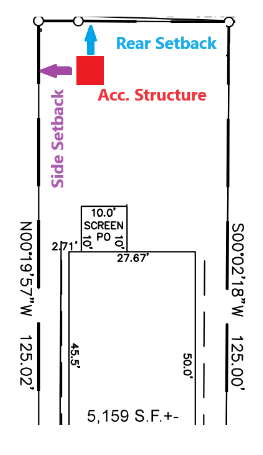
The number and location of accessory structures is regulated by the Town of Wake Forest Unified Development Ordinance 4.6(opens in a new tab)(opens in a new tab). Generally, Single Family Residential parcels less than 1 acre are limited to two accessory structures with a maximum of 600 Square Feet per structure with a maximum combined area of 1000 Square Feet.
In addition, setback requirements can differ from zone to zone. Residents can find their zone by searching their address in iMaps(opens in a new tab)(opens in a new tab) for Wake County or Franklin County GIS(opens in a new tab)(opens in a new tab) for Franklin County parcels. If the property is in a General Residential zone (GR3, GR5, GR10), the minimum setback for an accessory structure is 5 feet from the side property line and 10 feet from the rear. For other zones, refer to the tables in the following link UDO 2.2 District Provisions(opens in a new tab)(opens in a new tab).
For more specific information, contact a Planner at 919-435-9510.
How Do I Apply For A Permit?
All permitting is handled through GeoCivix. Please click the link for further instructions.
Search
Press Escape to close this dialog.