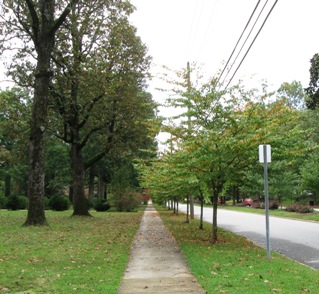
All trees located throughout the Town of Wake Forest make up the "Urban Forest". Trees that are located in the public right-of-way, on public grounds, and within street tree easements are municipal owned trees and are an important component of the Town of Wake Forest's urban infrastructure. Trees provide a wide variety of social, community, economic and environmental benefits for us all that include such things as climate moderation, better air quality, water conservation, habitat for birds and other wildlife and increased property values. All street trees located on municipally owned or controlled property are protected by the Vegetation Ordinance of the Municipal Code. The Town of Wake Forest requires street trees to be planted in all new developments. This requirement helps to ensure that Wake Forest remains a community of tree-lined streets with a unified streetscape that provides visual interest to pedestrians and motorists. The Town of Wake Forest is responsible for the planting, protection, maintenance and removal of these trees.
What is a "Town Tree"?
The Town of Wake Forest maintains trees growing on Town owned or controlled property. This includes public street rights-of-way, street tree easements, parks, greenways, and Town facilities. Trees along NCDOT maintained streets are the responsibility of NCDOT to maintain.
Who is responsible for maintaining the tree in front of my property?
The Town of Wake Forest's Urban Forestry Division is responsible for maintaining trees that are located within public street rights-of-way and street tree easements. Maintenance includes pruning, treating for insect and disease infestations, removal, stump grinding, and planting. The Town relies on homeowners to properly mulch and water the trees in front of their property.
How Do I Report Damaged or Diseased street Trees?
If a Town street tree is dead, injured, or suffering from pests or disease, please contact Luke Devores at ldevores@wakeforestnc.gov 919-435-9565.
How do I know if a tree is within the public street right-of-way or street tree easement?
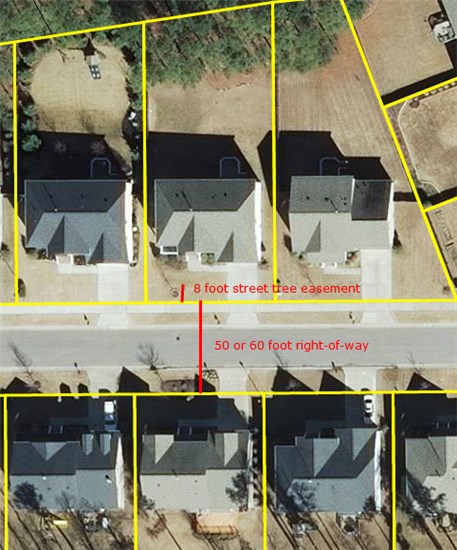
The street right-of-way is typically measured from back of sidewalk, to back of sidewalk (or if there are no sidewalks, property line to property line) perpendicular across the street. Trees planted between the curb and sidewalk, or between the curb and property line, are considered within the public right-of-way. Trees planted in a street tree easement are often planted within an 8-foot zone outside the right-of-way; in other words, 8 feet within the homeowner's property line.
I think my tree is a "Town Tree" and should be cut down. Will the Urban Forestry Division do that?
The Urban Forestry Division will remove trees on Town owned or controlled property under the following conditions: the tree is dead, or dying and unlikely to recover, infested with an insect or disease which would cause the death of the tree and is likely to spread to other trees, or the tree is determined to be a risk to life or property within the public right-of-way. A risk tree, as defined by the International Society of Arboriculture, must meet three criteria:
The tree or tree part has the size and weight to cause damage or injury if it were to fall, and
There is a target (the thing that would be damaged/injured if the tree or tree part were to fall), and
The tree has a condition that makes it likely that the tree or tree part would fall.
Trees that meet any of the above conditions for removal will be removed based on priority, with high risk trees taking top priority.
I don't like the street tree in front of my property; I don't want to rake leaves or pick up twigs; the tree shades my lawn so grass doesn't grow under the tree. Will the Urban Forestry Division remove this tree?
The Urban Forestry Division will not remove a street tree based on these, or similar, reasons alone.
Tree roots have pushed up the sidewalk, the curb, or my driveway. Will you cut the roots or remove the tree?
While tree roots can certainly contribute to pavement displacement, they are often not the initial cause of the problem. Many factors contribute to pavement failure, including method of construction, type of soil under and surrounding the pavement, proximity of the pavement to the tree's buttress roots, and others. There are several options for repairing damaged pavement while maintaining the health of the tree. The Urban Forestry Division will work with Street Maintenance to determine the best course of action for pavement repair and in the best interest of the tree. The Town is not responsible for repairing damaged pavement on private property.
What can I do about tree roots in my sewer or water line?
It is a common misconception that tree roots cause or create cracks in sewer and water lines. Roots are opportunistic when seeking out water and nutrients and will take advantage of existing cracks or leaks in pipes, but they are not jackhammers hammering against the pipe until it cracks. The best defense against tree roots in pipes is to ensure that your pipes are in good condition, with no cracks and tightly sealed joints. If it is determined that tree roots are growing into your sewer line, they can be removed through a process called "rodding". You may also use a commercially available product called RootX, to remove roots from sewer lines. The Urban Forestry Division will not remove a tree solely because of roots in lines. The Town is not responsible for repairing sewer or water lines on private property. The City of Raleigh is responsible for sewer and water line repairs within their utility easement.
There is a dead tree in the Town easement. Will the Town remove it?
Easements are agreements that allow one entity to install something (like a pipe or a utility line) under or over someone else’s property. In gaining the easement, maintenance responsibility does not transfer from the property owner to the easement owner. The responsibility for maintenance still lies with the owner of the property upon which the easement sits.
I have some concerns about a tree in my backyard. Can the Urban Forestry Division provide a diagnosis and recommendations?
The Urban Forestry Division cannot provide diagnosis or treatment recommendations, nor perform any tree work, on trees growing on private property, as this represents a conflict of interest and potential liability to the Town. For private tree work, you will need to hire a certified arborist. For tips on how to hire a certified arborist, click here. The Urban Forestry Division can provide basic tree care information such as proper pruning, mulching, planting and watering.
The tree on my neighbor's property makes me nervous. Will the Urban Forestry Division help me?
If you are concerned that the tree will fail and impact the adjacent street and sidewalk, then we are in a position to help. Per the Town's vegetation ordinance (revised Oct. 2016; approved Nov. 2016), the Urban Forestry Division can make a determination that a tree on private property may significantly impact public property or the adjacent right-of-way and request the tree's removal. However, if the tree is not likely to impact public property, that is a matter to be resolved between you and your neighbor.
My neighbor's tree is dead and decayed. It has already dropped limbs onto my property. I am concerned that this tree will fall onto my property and potentially injure my family or damage my property. Can I force my neighbor to cut down his tree?
In the interest of being a good neighbor, you should first talk to your neighbor about your concern in a rational manner. Point out the problem(s), clearly state your concern and ask him or her to remove the tree. If that approach fails, you might consider the following steps:
Contact a certified arborist who is Tree Risk Assessment Qualified (TRAQ) and ask him or her to evaluate the tree(s) in question. You can find a certified arborist who works in your area at http://www.treesaregood.org/. If the arborist finds there is no risk to you or your property, there is probably not much that you can do.
If the arborist's report recommends that the tree(s) come down, you should share that report with your neighbor and again ask him or her to remove the tree(s).
If the neighbor still refuses, then draft a letter stating that the arborist has found that the tree(s) threaten your property and recommends removal. Attach a copy of the arborist's report. Ask the neighbor to remove the tree(s) before they cause damage. Send the letter via return receipt certified mail as proof the neighbor received the letter.
If the neighbor fails to respond or still refuses to take action, follow up with a second letter. The second letter should contain the same information as the first letter. Add a paragraph advising the neighbor to contact his or her homeowner's insurance company about this risk and tell him or her that you are contacting your homeowner's insurance company. You can add that failing to notify his or her insurance company about the letter and arborist's recommendation may invalidate his or her insurance coverage. Send the letter via return receipt certified mail. You should send a copy of this letter to your homeowner's insurance company. This step usually forces action.
If the neighbor still refuses to act, you may consider speaking to an attorney to seek a court order requiring the neighbor to remove the tree(s). The fact that you took the previous actions before resorting to legal action will bolster your case.